2025 Annual Meeting
Imaginaries and Assemblages of Ageing Futures
Looking back…
The 7th annual meeting of the Socio-Gerontechnology Network was hosted at the KTH Royal Institute of Technology in Stockholm, Sweden. We thank everyone who contributed to the success of the conference, which aimed to raise awareness of the potentials and challenges – the imaginaries and assemblages – of interdisciplinary research in the field of socio-gerontechnology, as well as to share transformative knowledge that can contribute to policy and technological development for ageing futures in datafied societies.
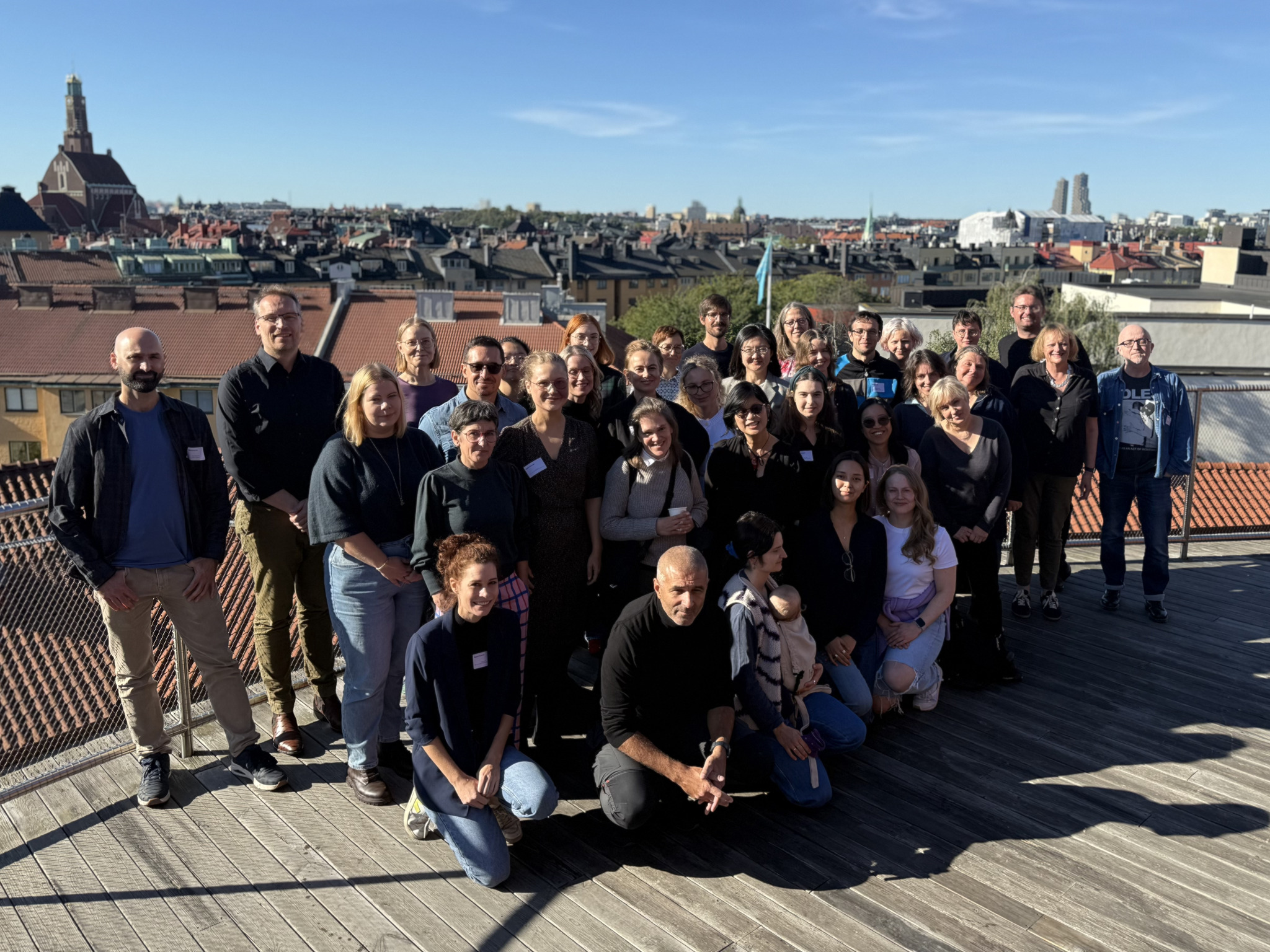
It started with a pre-conference for early career researchers in which we drew from experiences and lessons learned during the early stages of research. During the conference, we had the chance to take a look into each other’s research projects by engaging in a poster presentation as well as in symposiums.
The first day of the conference started with a session chaired by Vera Gallistl on “Generative AI and AI agents in ageing futures” where we learned from inputs on age imaginaries in generative AI and how to rethink ageism through intergenerational and situated representations, as well as on imaginaries of ageing futures in light of the reality of technological laboratory practices. Furthermore, we gained insight into how pet robots are included in the everyday life of people with dementia and on contesting anticipations about the future of “healthy ageing” through communicative AI.
The panel “AI agents and platforms in care work”, hosted by Carla Greubel, explored the promises, possibilities, and tensions around data-driven and Artificial Intelligence technologies in care practices for older people. From ambient assisted living and telecare sites to nursing homes and training programs for caregivers and community workers, the presentations illustrated recurring but also context-specific challenges in imagining and creating “good” ageing and care assemblages.
Wendy Martin hosted the session “Digital innovations and co-design approaches”. We learned about the so-called Tabletop Travels, boxes filled with different items from different places to help to build connections for older isolated adults. Furthermore, we drew from a collaborative project in long-term care where an AI-enabled robot was co-designed with residents, staff, and care leaders to shift its role from surveillance to supporting social engagement. A meta-analysis on the adoption of gerontechnologies, including AI-enabled bidets and their impact on caregiver burden, highlighted broader patterns in technology acceptance. Finally, we heard about multisensory hybrid artifacts designed to reimagine digital connectedness for people living with dementia.
Magdalena Kania Lundholm and Sanna Kuoppamäki then chaired the panel “Imaginaries and assemblages in interdisciplinary research in ageing and technology”. The goal of this panel has been to encourage an exchange and a dialogue about the imaginaries of aging and technology from an interdisciplinary and international perspective. The invited panelists, Lilian Hung, Alexander Peine and Iolanda Leite have different academic backgrounds and experiences and yet what they share are questions and research about the place of digitization and technology as important elements of ageing and later life. In the discussion panel we have departed from the idea that in the context of datafied societies, embracing dialogues between engineers and data scientists on the one hand and social scientists/ socio-gerontechnologists on the other, can enrich the knowledge and understanding of ageing futures and contribute to more socially conscious social and technological development. Topics that we discussed included, among others, current research questions and dilemmas in their respective fields, challenges of doing interdisciplinary research on the intersection of ageing and technology as well as advice to early career scholars in this field.


On the second conference-day we started with inputs on “Digital inclusion and exclusion in digital health and citizenship chaired by Mathias Denecke. The speakers of the first panel on Thursday morning mapped mechanism of inclusion and exclusion within the broader field of digital health and citizenship. Dennis Rosenberg opened the panel and interrogated the results from the “Survey of Health, Ageing, and Retirement in Europe”. Focusing on Internet use, Dennis traced the satisfaction of users in later life and unraveled at which point the Internet might be regarded as an alternative to social relations offline. Picking up on the usage of devices, Tien-Ying Lu put the lived experiences of older adults on center stage who make use of wearables which give real-time feedback on movement patterns. The idea to make adults take care of themselves by just providing the technology, Tien showed, is met with resistance and an intricately fragile relationship of device and user. Viivi Korpela ultimately introduced another case of in- and exclusion by analyzing access to digital public services. Viivi concentrated on feelings of imposition and frustration but also highlights that the life of adults can also become easier using digital services. The final discussion brought to the fore the resonances of the three presentations. The speakers pointed out implicit assumptions of successful ageing as well as ageism by design inherent in endeavors to include. The talks also showed that promises of inclusion by policy makers, engineers and designers are frequently met with the frustration of their users and may thus exclude them. Imaginaries of inclusion at times come as imposition, for example when users have to acquire a new set of certain skills to actually make use of a device or a service. Also, a one size fits all approach to building social relations on the Internet, using smart wearables, or accessing public services won’t do – usage has to be made to work individually. At its core, the panel complicated the relation of in- and exclusion.
Lily Ren then hosted a session on “AI and datafied care practices and infrastructures”. We heard about the SAGE project, in which immersive soundscapes of natural sounds among older people living in care homes were explored, followed by an input on whether AI can challenge its own bias and its role in mitigating algorithmic ageism, and another on mobilizing for solving ageing. The session closed with two talks: one analyzing how older adults negotiate ageing discourses on TikTok, and another exploring imaginaries of digital ageism, focusing on both stereotypes and self-stereotypes.
The conference closed with the final session hosted by Alexander Peine on “Imaginaries of ageing futures and ageing-in-place”. Together, the presentations in this session explored how ageing and technology co-shape each other, offering diverse contributions to socio-gerontechnology. Celia Brightwell examined the technological re-design of the ageing face through a case study of Morpheus8, raising questions about aesthetics, embodiment, and technological intervention. Her analysis highlighted how distinctions between the “new” and the “old” in both artifacts and organic beings expose ideologies of age embedded within technologies. Katri Keskinen shows how older adults maintain identity and independence by distancing themselves from assistive technologies, revealing that ageist and ableist assumptions exist not only in design but also among older adults, shaping temporal perceptions, technology acceptance, and imaginaries of ageing. Carla Greubel traced how past imaginaries of an automated pension system reshaped Germany’s welfare infrastructure, revealing how over-optimistic digital visions produced present fragilities. Her study exposed how older volunteer advisors now sustain the system, embodying the enduring labour and inequalities of failed sociotechnical futures. Magdalena Kania Lundholm used the concept of the “glitch” to reveal tensions between policy and practice in welfare technologies, highlighting disruption as a site of critique and change. This mapped to materialities, everyday practices, and also the critique of smooth techno narratives. Susan van Hees questioned how socio-gerontechnological approaches can inspire genuinely different imaginaries of ageing futures. She probed their limitations and impact, asking how rethinking average-based visions might foster more diverse, enduring, and transformative engagements between ageing, technology, and the practices shaping them.
…and looking ahead!
The next annual meeting of the Socio-Gerontechnology Network will take place in Berlin (Germany) in 2026. More information will be coming up soon.
Organisation Committee of the 7th annual meeting of the Socio-Gerontechnology
- Sanna Kuoppamäki, Assistant Professor, Department of Biomedical Engineering and Health Systems, KTH
- Magdalena Kania-Lundholm, Associate Professor and Senior Lecturer, School of Culture and Society, Dalarna University
From the Executive Board of Socio-Gerontechnology Network
- Wendy Martin, Chair of the Event Committee, Brunel University London, Global Public Health, UK
- Alexander Peine, Chair of the Executive Committee, Open University of the Netherlands, Department of Digital Culture, Innovation, Communication, the Netherlands


